Contact centers are under more pressure than ever. Customers expect instant, personalized support across channels, while leaders must control costs and keep agents engaged. Contact center automation tools sit right at the intersection of these demands, helping you do more with less while actually improving the customer experience. By leveraging Contact center AI for modern support and Virtual Agent Assist Reducing Workload, organizations can streamline workflows, boost agent productivity, and deliver seamless customer interactions.
This guide walks you through what contact center automation really is, the most valuable tools and features, and how to roll them out successfully. Whether you run a modest support team or a global service organization, you will find practical ideas to modernize your contact center without losing the human touch.
Leveraging Technology for Smarter Contact Centers
Modern contact centers rely heavily on technology to stay efficient. Many organizations are turning to advanced cloud computing and IT infrastructure solutions for business operations to streamline workflows, ensure high uptime, and provide agents with reliable tools to handle complex customer interactions. Cloud-based systems make it easier to scale resources as demand fluctuates, improving both agent efficiency and customer satisfaction.
High-performance computing is another critical element for modern support. Companies increasingly adopt enterprise-level supercomputing technology for faster data processing and AI analytics to enhance their contact center operations. These solutions empower teams to process customer information in real time, optimize routing algorithms, and provide personalized assistance with minimal delays.
Marketing-Driven Customer Engagement
Effective contact center automation isn’t just about technology—it’s also about connecting with customers strategically. Businesses can improve customer interactions by using comprehensive online marketing strategies for better customer engagement and retention. Integrating marketing insights with automation tools ensures that customer communications are tailored, timely, and relevant across all channels.
Additionally, implementing data-driven marketing campaigns designed to enhance online customer experiences and lead conversions helps organizations make automation smarter. By analyzing behavior patterns and preferences, automated systems can deliver personalized messages, offer context-aware recommendations, and reduce repetitive tasks for agents, resulting in smoother, more effective support.
Financial Planning for Automation Success
A critical part of deploying contact center automation tools effectively is proper financial planning. Businesses must allocate resources carefully to adopt the right technology without overspending. Utilizing top financial resources and strategies to optimize budgets for technology investments ensures that organizations maximize ROI while maintaining excellent service quality. Smart budgeting allows teams to invest in scalable systems, training programs, and analytics tools that drive both agent efficiency and customer satisfaction.
Top 10 Contact Center Automation Tools for Modern Support
Choosing the right contact center automation tools can transform your customer support operations, reduce agent workload, and improve overall service quality. Here’s a list of the top 10 solutions that organizations rely on to deliver seamless, AI-driven customer experiences.
1. Bright Pattern – AI-Driven Contact Center Solutions
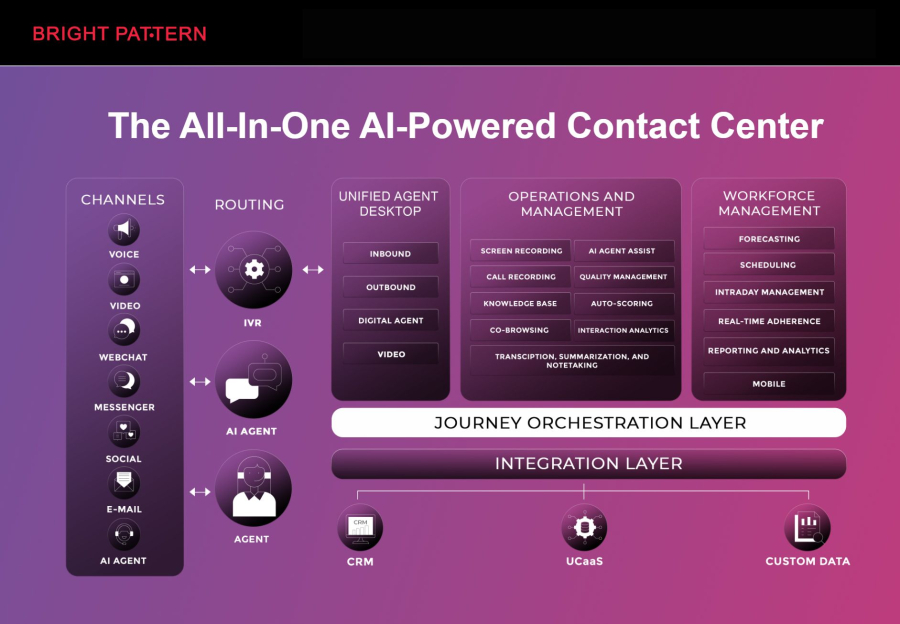
Bright Pattern leads the industry with its comprehensive AI contact center and call center solutions, helping businesses automate workflows while keeping customer interactions personalized. Its platform combines advanced routing, omnichannel support, and AI-powered analytics to boost efficiency and agent productivity.
Key features of Bright Pattern:
- AI-powered virtual agent capabilities to handle routine inquiries.
- Intelligent call routing to ensure the right agent handles each interaction.
- Integration with CRM and business software for a unified customer view.
- Omnichannel support including voice, chat, SMS, and social media.
- Analytics and reporting tools to monitor performance and optimize operations.
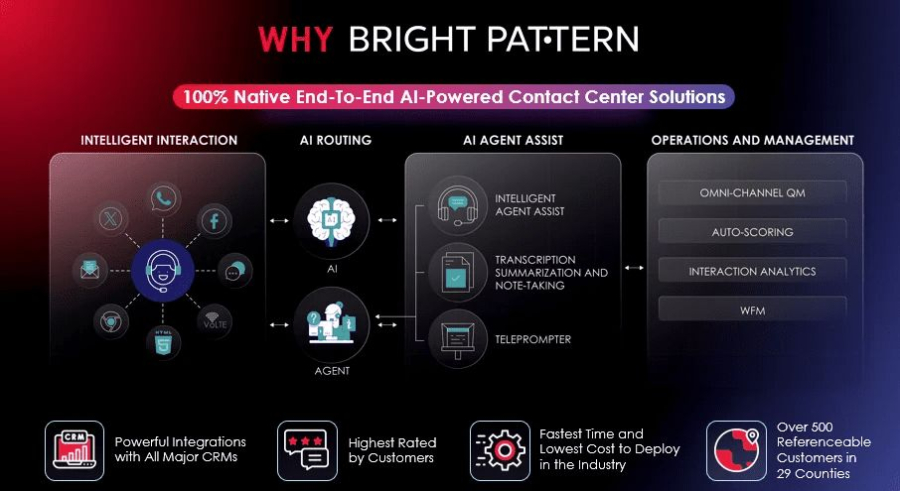
With Bright Pattern, companies can implement smart automation strategies that reduce repetitive tasks, improve response times, and maintain high-quality customer experiences. It is particularly suited for businesses looking to scale support operations with AI-enhanced efficiency.
2. Five9 – Cloud Contact Center Platform
Five9 offers cloud-based automation tools designed for both inbound and outbound customer support. Its AI capabilities include predictive dialing, virtual assistants, and intelligent routing.
3. Genesys Cloud – Omnichannel Customer Engagement
Genesys Cloud provides a unified platform for AI contact center solutions, enabling businesses to manage multiple communication channels with advanced analytics and automation.
4. NICE inContact – CX Cloud Platform
NICE inContact focuses on improving customer experiences with automated workflows, AI-driven interactions, and workforce optimization tools.
5. Talkdesk – Enterprise Contact Center Solutions
Talkdesk delivers cloud-based call center solutions with automation features, virtual agents, and AI analytics to streamline support operations.
6. RingCentral Contact Center – Intelligent Automation
RingCentral’s platform integrates AI for intelligent call routing, automated workflows, and analytics to optimize contact center performance.
7. Zendesk – Customer Service Automation Tools
Zendesk provides AI-driven automation tools for ticketing, live chat, and workflow optimization, helping agents resolve inquiries faster.
8. HubSpot Service Hub – Automated Support Platform
HubSpot Service Hub combines automation with CRM integration, offering tools to route inquiries, provide self-service, and monitor performance analytics.
9. Freshworks – AI-Powered Support Suite
Freshworks’ automation tools include AI chatbots, intelligent ticket routing, and workflow automation, designed to enhance efficiency across multiple support channels.
10. Salesforce Service Cloud – AI Contact Center Solutions
Salesforce Service Cloud integrates AI and automation to streamline case management, provide predictive insights, and improve agent productivity across all channels
What Are Contact Center Automation Tools?
Contact center automation toolsare technologies that streamline and partially or fully automate tasks that were previously done manually by agents, supervisors, or support staff. They use rules, workflows, and often artificial intelligence to handle routine work, guide agents, and orchestrate customer journeys.
Automation tools can work in the background (for example, routing interactions, logging notes, or updating systems) or directly with customers (for example, chatbots and self-service flows). The goal is not to replace humans, but to letpeople focus on complex, high‑value interactionswhile software takes care of the repetitive, predictable tasks.
Why Automation Is Now Essential in Contact Centers
Automation used to be a nice-to-have for high volume contact centers. Today, it is a strategic necessity for almost every customer-facing team. When implemented thoughtfully, contact center automation tools unlock powerful benefits:
- Faster responses and resolution times– Automated routing, self-service, and instant knowledge suggestions dramatically reduce wait times and handle times.
- Lower operating costs– By handling repetitive contacts and speeding up every interaction, automation reduces cost per contact and helps you scale without adding headcount at the same pace.
- Happier customers– Customers can solve simple issues anytime, anywhere, without waiting in a queue; when they need an agent, that agent is better prepared and more available.
- Less agent burnout– Automation removes tedious, manual work so agents can spend more time on meaningful problem solving and relationship building.
- Consistent quality and compliance– Workflows, prompts, and automated checks enforce your processes, policies, and regulatory requirements.
- Better decisions with real data– Automated analytics and reporting give leaders a real-time view of performance, demand, and customer sentiment.
In short, automation makes the contact centerfaster, more accurate, more scalable, and more humanat the same time.
The Main Types of Contact Center Automation Tools
"Contact center automation" is a broad umbrella. Below are the most common and impactful categories of tools and capabilities you will encounter.
1. Customer Self-Service and Deflection Tools
Self-service automation is all about giving customers a fast, convenient way to solve problems on their own, without speaking to an agent. Effective self-service not only improves customer satisfaction but also significantly reduces inbound volume.
- Interactive Voice Response (IVR)– Automated phone menus that route calls, provide information (such as order status or balance), and sometimes complete transactions through speech or keypad input.
- Chatbots and virtual agents– AI-driven bots that handle common questions, troubleshoot basic issues, and capture data before escalating to a human agent when needed.
- Automated callbacks– Tools that let customers request a callback instead of waiting on hold, automatically connecting them with the next available agent.
- Knowledge base and FAQs– Searchable articles, guides, and FAQs that customers can access on their own, often enhanced with AI search and suggestions.
When designed carefully, these tools provide24/7 support, deflecting repetitive inquiries while keeping agents free for complex cases.
2. Agent Assist and Productivity Automation
Agent assist tools augment human agents in real time. They reduce manual effort and provide the right information at the right moment, making agents both faster and more confident.
- Screen pops and unified desktops– Automatically display relevant customer data, interaction history, and context as soon as a contact arrives, so agents do not waste time searching multiple systems.
- Suggested responses– AI-driven or template-based suggestions for emails, chats, and social messages that agents can quickly personalize and send.
- Real-time guidance– Prompts, checklists, or scripts that adapt to what the customer is saying, helping agents follow best practices and compliance requirements.
- Automated after-call work– Automatic call logging, outcome tagging, and form completion to reduce wrap-up time.
- Robotic Process Automation (RPA)– Software robots that perform back-office tasks such as copying data between systems, updating records, and triggering follow-up actions.
By handling the repetitive parts of every interaction, agent assist toolsshorten average handle timeand improve both first contact resolution and agent job satisfaction.
3. Routing, Orchestration, and Workforce Automation
Automation does not only help in the moment of interaction; it also optimizes how work flows through your contact center and how your workforce is scheduled.
- Intelligent routing– Automatically route contacts to the best available agent or team based on skills, language, priority, and customer profile.
- Omnichannel orchestration– Coordinate interactions across phone, chat, email, social, and messaging so customers can move between channels without repeating themselves.
- Workforce management (WFM) automation– Forecast demand, generate optimized schedules, and manage intraday changes automatically.
- Automated notifications and alerts– Real-time alerts when queues grow, service levels drop, or customers have been waiting beyond your targets.
With effective routing and workforce automation, you reduce bottlenecks, protect service levels, and make sure every customer reaches the right person as quickly as possible.
4. Quality, Analytics, and Coaching Automation
Automation can radically improve how you measure performance and coach your teams by analyzing interactions at scale and surfacing actionable insights.
- Interaction recording and transcription– Automatically record calls, chats, and messages, then generate transcripts for search and analysis.
- Speech and text analytics– Analyze conversations for keywords, themes, sentiment, and compliance phrases.
- Automated quality scoring– Evaluate interactions against scorecards, flagging potential issues or coaching opportunities.
- Performance dashboards– Real-time dashboards that combine data from multiple systems into a single view for leaders and supervisors.
Instead of sampling a tiny fraction of interactions manually, you can automatically analyzeevery conversation, making quality assurance and coaching more targeted and effective.
Key Features to Look for in Contact Center Automation Tools
With so many options in the market, it is helpful to zoom in on specific features that deliver real value. The table below summarizes some of the most impactful capabilities and the business outcomes they support.
|
Feature |
What It Does |
Business Benefit |
|
AI Chatbots / Virtual Agents |
Automate routine customer conversations via chat or messaging. |
Deflect common inquiries, provide 24/7 support, reduce queue volume. |
|
Intelligent IVR |
Guides callers through menus, collects data, and performs simple tasks. |
Shorter wait times, fewer transfers, improved call containment. |
|
Skills-Based Routing |
Routes contacts to agents with matching skills and expertise. |
Higher first contact resolution, better customer satisfaction. |
|
Real-Time Agent Assist |
Suggests knowledge articles, answers, and next best actions during interactions. |
Reduced handle time, more consistent responses, faster onboarding of new agents. |
|
Automated After-Call Work |
Logs notes, dispositions, and updates systems automatically. |
Lower wrap-up time, more accurate data, less agent admin work. |
|
Speech / Text Analytics |
Analyzes conversation content and sentiment at scale. |
Identifies trends, issues, and coaching opportunities quickly. |
|
Workflow Automation & RPA |
Automates back-office processes triggered by interactions. |
Fewer errors, faster resolutions, streamlined end-to-end journeys. |
|
Workforce Management Automation |
Forecasts volumes and automates scheduling and intraday adjustments. |
Optimized staffing, controlled labor costs, stable service levels. |
How Automation Transforms Common Customer Journeys
The real power of contact center automation tools becomes clear when you map them to specific customer journeys. Here are a few examples of how automation can transform everyday scenarios.
Order Status and Shipping Inquiries
- Customers use a chatbot or IVR to enter an order number.
- The automation tool fetches real-time status from your order system.
- It provides tracking details instantly, without using agent time.
- If the customer still needs help (for example, a lost package), it routes them to the right team with the order details already on screen.
Outcome:High-volume, low-complexity questions are handled automatically, while exceptions reach agents fully contextualized.
Technical Support and Troubleshooting
- A virtual agent guides the customer through basic troubleshooting steps.
- If unresolved, the tool routes the case to a specialized agent with a summary of steps already attempted.
- During the call or chat, real-time agent assist suggests additional steps and knowledge articles.
- Afterward, notes are logged automatically and a follow-up email or message is triggered.
Outcome:Shorter time to resolution, less repetition for customers, and fewer manual tasks for agents.
Billing and Account Changes
- IVR or self-service portals allow customers to update payment methods, check balances, and download statements.
- Rules and workflows validate the changes and update core systems.
- If the customer needs clarification, they can speak to an agent who already sees the latest account information.
Outcome: Customers gainconvenient, self-directed controlover their accounts, while agents focus on exceptions or high-value conversations.
A Practical Roadmap to Implementing Contact Center Automation
Successful automation is not about deploying every feature at once. It is aboutprioritizing the right use casesand rolling them out in a controlled, measurable way. Here is a step-by-step roadmap you can adapt.
- Map your top contact reasons.
- Analyze interaction data to find your highest volume contact types.
- Look for patterns such as repeat questions, simple transactional requests, or predictable workflows.
- Identify quick win automation opportunities.
- Target low-complexity, high-volume interactions first (for example, order status, password resets, basic FAQs).
- Assess which steps can be automated safely without degrading the experience.
- Choose your automation tools and architecture.
- Decide whether you will use a single platform or integrate multiple specialized tools.
- Ensure integration with your CRM, ticketing, and core business systems.
- Design customer-centric flows.
- Start with the ideal customer experience, then design automation around it.
- Keep flows simple, clear, and always offer an easy path to a human agent.
- Pilot with a small audience.
- Test new automations with a subset of customers or a limited set of scenarios.
- Measure containment, satisfaction, and impact on agents before expanding.
- Train and empower your agents.
- Explain how automation will support them, not replace them.
- Provide training on new tools, dashboards, and workflows.
- Invite feedback and ideas for further automation improvements.
- Monitor, refine, and expand.
- Track key metrics continuously (for example, handle time, CSAT, self-service usage).
- Iterate on scripts, flows, and rules based on real-world results.
- Gradually add more complex use cases as your team gains experience.
Measuring the ROI of Contact Center Automation
To build long-term support for your automation strategy, you need to demonstrate tangible results. The most effective programs define a clear baseline, then track a mix of efficiency and experience metrics.
Efficiency and Cost Metrics
- Self-service containment rate– Percentage of interactions fully resolved without human intervention.
- Average handle time (AHT)– Time from contact start to completion, including talk and after-call work.
- Cost per contact– Total operating costs divided by number of handled interactions.
- Agent occupancy and utilization– How much time agents spend engaged in productive work.
- First contact resolution (FCR)– Percentage of issues resolved in one interaction.
Customer Experience Metrics
- Customer Satisfaction (CSAT)– Survey scores following interactions or across channels.
- Net Promoter Score (NPS)– Customer likelihood to recommend your brand.
- Customer effort score– How easy customers find it to get help and resolve issues.
- Queue times and abandonment rates– Indicators of how long customers must wait for human support.
Employee Experience Metrics
- Agent satisfaction and engagement– Surveys about workload, tools, and work environment.
- Agent turnover and absenteeism– Indicators of burnout and morale.
- Time to proficiency for new hires– How quickly new agents reach target KPIs.
When you connect the dots between these metrics and your automation initiatives, you build a strong, data-backed case for ongoing investment.
Keeping Automation Human: Best Practices for a Great Experience
The most successful contact centers treat automation and human service as complementary, not competing, capabilities. Use these best practices to keep automation human-centered and trustworthy.
- Always offer an easy escape to a human.Let customers transfer to an agent at any point, especially if they indicate frustration or complexity.
- Be transparent.Clearly show when customers are interacting with a bot or automated system, and what it can and cannot do.
- Use natural, friendly language.Design IVR prompts and chatbot scripts that sound like a helpful human, not a rigid machine.
- Personalize where possible.Use available data (such as name, account type, or recent interactions) to tailor experiences and avoid asking for the same information repeatedly.
- Continuously train and refine AI models.Regularly review logs, correct misunderstandings, and update knowledge to improve accuracy.
- Protect privacy and comply with regulations.Ensure your automation tools handle personal data safely and transparently.
- Involve frontline teams in design.Agents and supervisors know where automation will help most and where a human touch is critical.
Example: A Simple Automated Workflow in Practice
To illustrate how tools fit together, here is a simplified pseudocode-style example for an automated "order status" flow:
IF customer contacts via chat OR messaging: BOT: Greet customer and ask for order ID. IF order ID is valid: Fetch order status from order system. IF order is shipped: Show tracking link and estimated delivery date. ELSE IF order is processing: Inform customer of current stage and expected ship date. ELSE: Offer to connect to a human agent. ELSE: Offer to connect to a human agent. IF customer requests an agent at any point: Route to agent with chat transcript and order details attached.
This type of workflow can be configured visually in many contact center platforms, combiningself-service automationwithseamless escalation to humanswhen needed.
Choosing the Right Contact Center Automation Strategy for Your Organization
There is no one-size-fits-all approach to automation. The right mix of tools and use cases depends on your business model, customer expectations, regulatory environment, and internal capabilities.
To shape your strategy, ask:
- Where are our biggest pain points today?Long wait times, high turnover, inconsistent quality, or limited hours of operation?
- Which interactions do customers find most frustrating?Repetitive questions, billing disputes, technical issues, or onboarding?
- What systems and data do we need to connect?CRM, ERP, order management, billing, or marketing platforms?
- How ready is our organization for change?Do we have champions, cross-functional support, and resources for training and continuous improvement?
By aligning automation initiatives with strategic priorities and customer needs, you turn technology investments into visible business outcomes.
Frequently Asked Questions About Contact Center Automation Tools
Will automation replace human agents?
Well-designed contact center automation toolsaugment, not replace, human agents. Automation excels at repetitive, rules-based tasks, while humans excel at empathy, complex problem solving, and relationship building. Most organizations use automation to free agents from low-value work so they can focus on interactions that truly need a human.
How complex is it to get started?
You do not need to automate everything at once. Many tools allow you to start with targeted use cases, such as a simple chatbot for FAQs or automated after-call work. By beginning with smaller, well-defined projects, you can deliver quick wins and build internal confidence before tackling more complex end-to-end workflows.
Is automation only for large contact centers?
No. While large enterprises often lead adoption, smaller and mid-sized teams can benefit significantly from automation as well. Even a modest support operation can use tools like smart routing, templates, basic bots, and workflow automation to reduce manual effort and improve responsiveness.
How do we ensure our automation remains accurate and relevant?
Continuous improvement is essential. Monitor interaction logs, review common failure points, and update flows, content, and AI models regularly. Involve agents and supervisors in this review process; they will quickly spot where automation supports or hinders daily work and customer satisfaction.
Conclusion: Turn Your Contact Center into a Strategic Advantage
Contact center automation tools are more than a way to cut costs. When thoughtfully implemented, they become a powerful lever to deliverfaster service, more consistent quality, and richer customer experienceswhile creating a more engaging workplace for agents.
By combining self-service, intelligent routing, agent assist, and analytics automation, you can transform your contact center into a proactive, data-driven hub that supports the entire customer journey. Start with your highest-impact use cases, measure results carefully, and keep your focus on human needs. The result is a contact center that not only keeps up with rising expectations, but turns service into a true competitive advantage.
